Arrests.org CT: Official Connecticut Arrest Records & Erasure Guide
Finding arrest records or mugshots in Connecticut is entirely different from the rest of the country. Connecticut does not have a county sheriff system, which means standard methods for finding inmates do not work here. Whether you are trying to verify a loved one’s booking status or need to scrub your own expunged record from the internet, you need specialized guidance.
🔍 1. How to Search Connecticut Arrests (Step-by-Step)
If you want a quick visual overview of recent bookings, Arrests.org aggregates data from municipal police feeds. Here is how to use it:
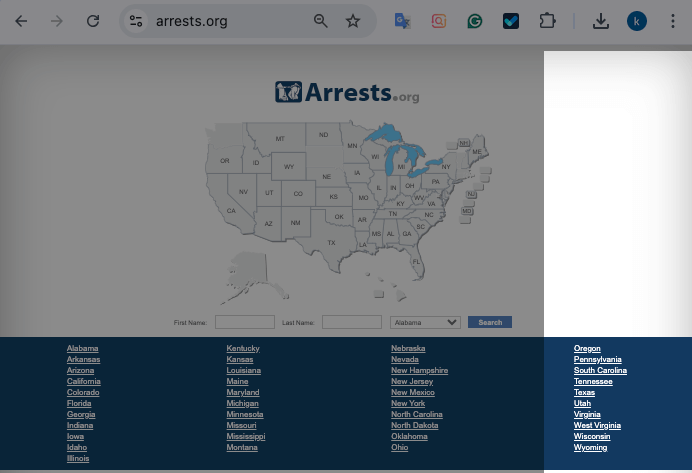
Visit the State Portal: Open the official state database at connecticut.arrests.org.
Bypass the County Issue: You will see a list of counties (like Fairfield, Hartford, or New Haven). While CT doesn’t have county governments, Arrests.org still sorts the municipal police data geographically. Select the area where the arrest occurred.
Execute Name Search: Use the search bar to type in a first and last name, or browse the recent blotter.
Extract Booking Data: Review the profile carefully. Note the specific Statute Charges (like Breach of Peace or Larceny) and the arresting agency.
🏛️ 2. Official Connecticut Search Portals (The Source of Truth)
Critical Fact: Connecticut operates a unified court and prison system. There are no county jails. If someone is arrested, they are either held at the local town police department or transferred immediately to a State Department of Correction (DOC) facility. You must use these state-level tools.
Agency / Jurisdiction | Official Resource | Search Tool & Details |
|---|---|---|
Statewide Inmates | CT Department of Correction | 🔗 CT DOC Offender Search Search for anyone currently incarcerated or awaiting trial in a state facility. Requires Name and DOB or Inmate Number. |
Pending Court Cases | CT Judicial Branch | 🔗 Criminal Case Look-Up The ultimate source for finding upcoming arraignment dates, bond amounts, and pending charges. |
Criminal Backgrounds | CT DESPP / State Police |
⚖️ 3. Connecticut FOIA & The Erasure Statute
Connecticut has very specific laws balancing public transparency with the right to clear your name after a dismissed case.
The CT FOIA Arrest Record Law (C.G.S. § 1-215)
Under Connecticut’s Freedom of Information Act, police “blotter” information is undeniably public. This means law enforcement must release the name, race, address, time of arrest, and charges of any adult arrested. This is why data brokers can legally scrape and publish this data.
Connecticut’s Erasure Statute (C.G.S. § 54-142a)
If you are found not guilty, or if your charges are dismissed or “nolled” (the prosecutor drops the case), your record is subject to the Erasure Statute. By operation of law, these records are automatically erased (usually 20 days after a dismissal, or 13 months after a nolle). Once erased, you can legally swear under oath that you have never been arrested, and data brokers are legally obligated to remove your profile.
🛑 4. Arrests.org Opt-Out: Remove Your CT Mugshot
If your case was dismissed or erased under Connecticut law, you shouldn’t have to suffer reputational damage online. Arrests.org provides a free opt-out process.
Locate Your Record ID: Find your profile on Arrests.org. Look at the URL in your browser’s address bar. Copy the numbers at the exact end of the URL (e.g., .../Connecticut/12345678 -> Your ID is 12345678).
Access the Hidden Portal: Type this exact URL into your browser, replacing the brackets with your ID: https://arrests.org/remove/?id=[Insert Your ID]
Upload Legal Proof: Upload a scanned copy of your official court disposition showing the case was dismissed or erased. Also upload a redacted copy of your State ID.
💰 5. Bail Bonds & Arraignment Info
The Arraignment Process
When arrested by local municipal police in CT, the individual is usually held at the local police station until their arraignment on the next business day at the regional Geographical Area (GA) courthouse. It is at this hearing where the judge sets the official bond.
Securing Release
- 💵 Cash Bond: You pay the full cash amount directly to the court clerk. It is refunded when the case concludes.
- 📜 Professional Surety Bond: You hire a licensed CT Bail Bondsman. You pay a non-refundable premium (state law dictates the fees: usually 10% up to $5,000, and 7% for the amount over $5,000).
- 🤝 PTA (Promise to Appear): The judge allows the individual to leave for free, based strictly on a written promise to return for court dates.
❓ 6. Frequently Asked Questions
A “nolle prosequi” means the prosecutor has chosen not to prosecute the case at this time. Under CT law, nolled charges hang over your head for 13 months. After 13 months, they are automatically dismissed and erased by operation of law.
No. Under state law, records for people under 18 (and those granted Youthful Offender status) are strictly sealed to protect their future prospects.
No. Connecticut does not have county government. Inmates are held at local police lockups for a few hours/days, and then transferred into the statewide Department of Correction (DOC) prison system.